
Bluegrass Music in Portage County

As part of our PCHS feature exhibit, each month through December of 2026 we will share a new piece of music history. Be sure to come back to learn more about the music that makes Portage County so great!
Bluegrass Music in Portage County was researched and written by Art Stevenson.
What is Bluegrass Music?
In 1945, mandolinist, Grand Ole Opry member, and Kentucky native Bill Monroe added banjo virtuoso Earl Scruggs to his five-piece band, which Bill called his Bluegrass Boys. Monroe recorded dozens of records with his brother Charlie in the mid-1930s featuring old time duet singing and Bill’s ground-breaking mandolin playing. Since breaking up the successful Monroe Brothers duo in 1938, Monroe had been working steadily on his string band, adding a musician here, dropping one there, slowly and steadily improving the rhythmic drive, the instrumental soloing, and the singing. A thumping bass fiddle, strong rhythm guitar, old timey clawhammer–style five string banjo, a breakdown fiddle player who could get any audience on their feet dancing; Bill Monroe’s virtuosic 90 mile-an-hour mandolin solos, his spirited lead and harmony singing, and his band’s powerful rhythmic drive were what made Bill and his Bluegrass Boys a big attraction to Southern audiences. Bill Monroe and some of his Bluegrass Boys wrote songs, adding to the traditional mountain songs, fiddle tunes, Bill’s high tenor singing of his favorite Jimmie Rodgers blue yodeling songs, and sacred numbers in their repertoire – the Bluegrass Boys even featured a Gospel singing quartet! By 1939 Bill Monroe and His Bluegrass Boys were members of the Grand Ole Opry in Nashville, Tennessee. The Grand Ole Opry shows were broadcast nationally on WSM 650 AM Nashville, giving the group major exposure.

Earl Scruggs, a young five-string banjo picker from Shelby, North Carolina, came to Nashville in 1945 to audition for Bill Monroe. Earl’s banjo style was based on a pattern of repeated triplets, or rolls, played with thumb and fingerpicks. The rolls could be fit to the song melody, improvised, and played at very fast tempos, which Bill and his Bluegrass Boys were comfortable with. This was an exciting, progressive innovation beyond the clawhammer or frailing style of banjo picking, which had been dominant for many years in Southern string band music. In fact, nobody had heard anything like what Earl Scruggs was playing on the banjo in 1945. Bill Monroe auditioned Earl and tried him out on the Grand Ole Opry, where Earl’s new banjo style drove the Opry audiences wild!
Earl Scruggs and his banjo became an overnight sensation, and before long his three-finger roll came to be known as Scruggs-style, or Bluegrass style banjo picking. Music writers and historians point to this event as the birth of the Bluegrass style of music, Earl’s banjo being the final ingredient that set Bill Monroe’s progressive string band music apart from other styles of country and hillbilly music popular in the 1940s. Before long, other artists began copying and recording Bill Monroe’s Bluegrass style, with numerous banjo players learning to play like Earl Scruggs. The most successful of these new groups was Flatt and Scruggs & The Foggy Mountain Boys, formed when Lester Flatt and Earl Scruggs left Bill Monroe’s Bluegrass Boys to start their own show.

Bluegrass Music Comes North!
Until the 1960s, few Portage County residents were aware of or interested in Bluegrass music. After all, Bluegrass came from the South and isn’t native to Wisconsin; the music had to be introduced here through radio and appearances by country music acts. Starting in the 1920s, clear channel AM radio shows in Chicago, Minnesota, and more distant locations carried country music specials, like the National Barn Dance on WLS, and the Sunset Valley Barn Dance on KSTP in St. Paul. These clear channel broadcasts could be picked up by parlor radios hundreds of miles away at night. Yodeling cowboys, string bands, fiddlers, and country music stars could be heard on the radio, and occasionally a group of artists from the Grand Ole Opry or the National Barn Dance would perform at the Fox Theater in Stevens Point, or at local county fairs and dance halls. The increasing popularity of Folk Music in the early 1960s, with its acoustic guitars, banjos, and harmony singing raised awareness and interest in bluegrass music among audiences in Northern states, and in urban areas. It’s hard to determine exactly when Bluegrass came to Portage County, but Flatt and Scruggs & The Foggy Mountain Boys played in 1964 at the Wisconsin State Fair, and they appeared as guest stars on the popular banjo - driven television show “The Beverly Hillbillies” around the same time. The music of Flatt and Scruggs was widely available on record and was heard on local country music radio stations from time to time. It was just a matter of time before local interest reached a creative point.

Bluegrass Bands and Moments to Remember:
Safety Last String Band (1970-1976) Portage County’s first popular string band played a blend of folk, blues, and bluegrass music. Safety Last String Band was organized in 1970 by banjoist and Stevens Point native Paul Bentzen. Paul learned to play banjo by listening to Flatt and Scruggs records, especially the Foggy Mountain Banjo instrumental album. Without having any other banjo players around to help or give lessons, Paul Bentzen was the first Scruggs-style banjo player in Stevens Point, and from 1970 to 1976 he led Safety Last String Band, with guitarist Mike Dowling, bassist John Ulrich, and Mike Weist on mandolin and guitar, as the original members. Later members of Safety Last included Jerry Laszewski, guitar; Tom McComb, mandolin; Baird Callicot, upright bass; Tony Menzer, upright bass; and Joe Ebel, fiddle.
Paul Bentzen and Joe Ebel in 1977, photographed for the Wisconsin Rapids Daily Tribune.
Wheatstone Bridge Band (1975-1978): In 1975, I was a student at SPASH, and sometimes I’d eat lunch off-campus at a little doughnut and sandwich restaurant on Division Street. After school one day, the band Wheatstone Bridge was playing there, with Otis McClennan on bass, harmonica, and banjo; Mike Mueller also on banjo, along with two other musicians. Wheatstone Bridge was a country rock band, using the banjo on just a few songs, and although they weren’t a bluegrass band, two of the band members could play five string banjo, and they worked the banjo into their shows here and there. Guitarist and songwriter Don Bren may have been in the band then. Of course, Otis McClennan played in numerous bands throughout the years in Stevens Point, the best-known being the blues band Otis and the Alligators. Mike Mueller was a student at UWSP in the late 1970s and was a fine Scruggs-style banjo picker. Mike gave lessons to younger players here in the late 1970s before moving to Milwaukee, where he is still active and playing banjo with Sawdust Symphony, a popular bluegrass group. It should be noted that Frank Stanislawski of Daddy Whiskers, and Jim Prideaux of Heart Strings, played electric guitar in local mid-1970s country rock bands, and both were known to play five string bluegrass–style banjo occasionally on their shows.

Blue Mountain Bluegrass Band (1977-1985): In the fall of 1977 I enrolled as a freshman at UWSP and moved into Knutzen Hall on campus. I was already playing a little bit of guitar, singing a little, and playing a whole lot of harmonica. I had been to the Mole Lake Bluegrass Festival near Crandon, and I’d caught the Bluegrass Bug. I was already collecting bluegrass and old-time music records, saving money by checking them out from the library or borrowing from friends, and making cassette tape copies. As luck would have it, a student living down the hall from me played bluegrass music! Peter “Jed” Malischke was a capable Scruggs-style banjo player, and he could sing lead or harmony. He had friends on and off campus who played bluegrass and they were in the process of starting a band called Blue Mountain Bluegrass Band. Jed Malischke played banjo, Donald “Zeke” LaChappelle played mandolin, Andy Schoofs played lead guitar, Jeff Naden played Dobro and guitar, Pete Anderson played upright bass, and I joined the band as a harmonica player. Most of us could sing lead and harmony. We even had a sound engineer, Jim Rhode, with us on most shows. Jeff, Jed and Zeke were good at getting the band booked at campus events and local bars and in a short time we started to get busy. In 1978 the legal drinking age was 18, and we’d play at Ella’s on Division Street and charge only 50 cents for admission. The place was so packed you could hardly move. We made demo tapes at Sojourn Studios in Stevens Point and played a lot of the country bars around Portage County. A couple of those places were pretty rough, with people yelling out requests that we didn’t know, and occasional fistfights in the audience. In 1978 Andy Schoofs and Jeff Naden left the band and Len Halvorson joined on guitar and as a lead vocalist. By 1979 Blue Mountain Bluegrass Band was based off-campus. Jed lived on Phillips Street, and Len and I lived two blocks away at the corner of College Avenue and Division Street. Meanwhile, Zeke got an upstairs apartment on North Second Street next to Gary Bartig’s music store. It seemed we were always hitting the road on weekends, playing all over Wisconsin, and attending every bluegrass show we could find when we had a day off. We knew all the other Wisconsin Bluegrass bands back then – Grass, Food, and Lodging; Piper Road Spring Band, Alive and Picking, Just Friends, Yankee Coalition, the Monroe Doctrine, Stone Oak, and more. Many of those bands appeared at the Second Street Pub north of town, and on the UWSP campus. Many of those musicians are still playing music 45 years later! Some of the biggest shows we played were the Mole Lake Bluegrass Festival near Crandon, a big country music show in Oshkosh with Dave Dudley, the 1978 UWSP Telethon which was on local television here, and a couple of bluegrass festivals near Milwaukee with national acts. Our typical shows included rollicking bluegrass banjo tunes, popular bluegrass songs like Fox On The Run, mountain and cabin songs with three part harmony, rural blues numbers, and the occasional country song. Jed, Len, Zeke, and I took turns at lead singing, and we all pitched in on harmony singing. Bass player Pete Anderson was a UWSP music student and helped the band work out the vocal harmony parts.
By 1980 I was tired of the rigors of playing music every weekend, and I left Blue Mountain Bluegrass Band to travel and visit family in New England and take a break from the music business. Fiddler/mandolinist Gary Bartig, of Nelsonville, joined the band. Blue Mountain continued as a popular bluegrass band into the mid-1980s, making a cassette recording of the band at that moment in time. I sat in with them from time to time during that period. Eventually, as their college careers finished and the band members moved to various parts of Wisconsin and Upper Michigan, Blue Mountain Bluegrass disbanded after eight years of playing Bluegrass music in Stevens Point and around the state. Bassist Peter Anderson is still playing Bluegrass music in Madison with The Soundbillies, after playing symphonic music for years. For a long time, Jed Malischke was a board member of the Minnesota Bluegrass and Old Time Music Association, and his leadership was instrumental in helping the organization, and its bluegrass festivals and concerts, to grow and thrive. Jed plays banjo and guitar in The Truegrass Trio in northwestern Wisconsin, and he is the executive director of the Wisconsin Canoe Heritage Museum. Sadly, guitarist and singer Len Halvorson passed away in 2024.
Blue Mountain Bluegrass left a legacy of friendship and community. The core band members are still in touch after all these years. Many of the fans who met at Blue Mountain’s shows are still friends, and I recall fans who danced together at Blue Mountain shows later getting married; the band may have played at weddings of these fans. As an interesting footnote, Blue Mountain Bluegrass was the first Portage County band to identify and dedicate itself to being a Bluegrass band!
Heartland Music and Repair was an acoustic music store owned and operated by Gary Bartig and Kurt Landauer from 1980 to 1982. The store was located on Second Street just north of downtown Stevens Point, and was dedicated to acoustic music, offering acoustic guitars, mandolins, fiddles, banjos, dulcimers, autoharps, and other instruments for folk, bluegrass, and old-time musicians. Strings, capos, picks, bows, books, records, and other supplies were kept in stock. Kurt Landauer and Gary Bartig were both experienced musicians and skilled luthiers, offering expert repairs and maintenance on acoustic instruments. The store offered lessons and workshops on mandolin, guitar and fiddle. Folk musicians performing in Stevens Point would present workshops at the store, before their concert appearances. Heartland Music and Repair was one of just a few stores specializing in acoustic music in the state of Wisconsin at that time. Sadly, the niche market of acoustic musicians in central Wisconsin could not sustain this excellent music store, and after just two years in business, Heartland Music and Repair closed its doors.
Raiders of the Lost Barn (1986-1998) Fiddler/mandolinist Gary Bartig, of Nelsonville, and three Waupaca County musicians organized this group as a square dance band. Pat Wiley played guitar and fiddle; John “Dub” Wilson played banjo and clog danced, and Laurie Ryan played guitar and pedal bass. Gary Bartig was the only Portage County member of Raiders of the Lost Barn. Although they did not play bluegrass, the music they played was old-time string band music, a progenitor of bluegrass music. The band played for square dances (preferably in barns), weddings, Civil War reenactments, buck skinner gatherings, small town festivals, and corporate dinners, all over Wisconsin. John Wilson, Laurie, and Pat Wiley took turns at calling the dances. The caller would walk out onto the dance floor with a microphone and instruct the square dancers, and remain on the floor as the dance progressed, calling the dance and coaching and encouraging the dancers, while the band fiddled and picked a sprightly, danceable instrumental tune, like Red Haired Boy, or June Apple. Square dancing, with a live band or with recorded music, was very popular in the 1970s and ‘80s in central Wisconsin, and Raiders of The Lost Barn were a dedicated square dance band.
Pat Wiley, songwriter and member of Raiders of the Lost Barn, wrote this poem:
The Raiders of the Lost Barn (Patrick Wiley, 1987)
There was a time long ago in this here land, not far from this very spot which we stand
When people worked hard and took pride in their labors, where folks helped one another, and neighbors were neighbors
Come Saturday night when the work was all done, they were never too tired to make their own fun
Whole families would travel down long dusty roads to some schoolhouse or barn they’d come by the wagon loads
From inside fiddles and banjos and accordions they’d hear, which put smiles on the young ones and to those up in years
Then they’d all go inside and dance until dawn, eat and tell stories, and laugh and carry on.
When the young ones would get tired, they’d stroll up by the band, curl up in a blanket and drift off to dreamland.
And while they lay sleeping their spirits would soar to the beat of shuffling feet on that old wood dance floor.
So, in some old lost barn they were just stored away, left there forgotten like old bales of hay.
But as the years added up, so did folks discontent, and they wondered where all these good times had went.
They grew tired of the bars, fast cars and TV, and longed for the way that life used to be.
So some sought out their elders, those few left around, and begged them to tell us where these good times could be found.
And tell us they did in songs, dances, and yarns, for not a place but their memories proved to be that lost barn.
And there tucked safely in those dark creaky rafters, were countless old treasures, the very ones we were after.
No, we found no diamonds or silver or gold, but the spirit of a people, and community, that should never have grown cold.
It is of these people and times we do sing, in hopes that in some small way some joy it may bring
So God bless those who saved it and kept it from harm. Bless those too who revive it…
The Raiders of the Lost Barn

Wisconsin River Bluegrass Boys (1982-1999) By 1981 I was studying physics at UWSP, playing blues with Generic Blues and Boogie Band, and jamming with local acoustic musicians. Besides Blue Mountain Bluegrass, some of the local pickers who played Bluegrass Music around Stevens Point at that time were Al Pieper, Marty Nellesen, Lisa Marchel, and Gary Bartig. While watching a Milwaukee-area bluegrass band play at a bar near campus, I met another UWSP student, Chicago-born Art Lies, who sang and played guitar, banjo, and mandolin. We started playing music together and in 1982 we formed a band which we named the Wisconsin River Bluegrass Boys. We learned many traditional bluegrass songs, singing as a duet, and taking turns singing leads. Before long, my brother Ken Stevenson joined us on upright bass, and Lisa Marchel, who I first met in junior high school, played fiddle. Occasionally, Joe Ebel would sit in on fiddle. Art Lies got us booked at campus events and at local bars, and in 1983 we played at a bluegrass and folk music festival on the UWSP campus, which was covered by the Stevens Point Daily Journal, with a picture of us playing. During this early period, Art Lies and I were a versatile act, comfortable playing as just a duo, or we could add extra musicians if we needed a full combo. At that point in time, the only other Stevens Point-based bluegrass band was Blue Mountain Bluegrass.
By 1984, Wisconsin Rapids guitarist/bassist Brian Jennings had joined the band, and other musicians were brought in to play dates as needed, including Marty Nellesen of Stevens Point on banjo; fiddler and mandolinist Gary Bartig of Nelsonville; fiddler Clyde Thompson, from Janesville; my old bandmate Jed Malischke on banjo; and bassist Bob Stanton, of Madison. The Wisconsin River Bluegrass Boys developed a following in southern Wisconsin and northern Illinois, and we appeared at numerous events, clubs, ballrooms, and music festivals in those regions. We were based in Stevens Point until 1985. The future of the band was put on hold when Art Lies moved to Madison, and I moved for six months to Lexington, Massachusetts, to live with relatives and play bluegrass music with Boston-area bands (The Fiction Brothers and Zion Mountain Boys).
I moved back to Stevens Point in the summer of 1985, and Art Lies and I revived the Wisconsin River Bluegrass Boys. Art Lies was living in Madison, and in 1986 I moved there and shared a house with Art and banjo player Dale Reichert, who we had met in 1985 in Minnesota. Upright bassist Dave “Hagar” Nelson of Milwaukee filled out our quartet, and on a trip to Indiana we caught the attention of the Father of Bluegrass Music Bill Monroe, who invited us to play in Nashville, Tennessee at Opryland, which led to an appearance on WSM’s Midnight Jamboree. In the late 1980s we released several cassette albums, and played at festivals and events in Tennessee, Kentucky, Indiana, Michigan, Illinois, Minnesota, and Iowa, as well as numerous appearances around Wisconsin. I moved back to central Wisconsin in 1988 to pursue a teaching career, living in a cabin on Sunset Lake and later in Stevens Point, all the while continuing to play with the Wisconsin River Bluegrass Boys as guitarist, lead singer, and harmonica player. I produced and hosted the radio show “Acoustic Revival” on WWSP 89.9 FM Stevens Point from 1989 to 1991. As my play date schedule increased, it became difficult for me to continue as Acoustic Revival’s Sunday morning host. I gave the show up to new hosts - Al Pieper and Tim Krogman in the early days – and it’s great to see the Acoustic Revival show is still on the air at WWSP today, 36 years later! In 1990 I started hosting an acoustic open mic every Thursday night at The Cabin (which became Witz End a few years later). I worked as a duo with a succession of talented partners at The Cabin every Thursday for over a year: first with Dave Stoddard on piano, then the Wisconsin Rapids guitarist and singer Tom Boyarski, and finally troubadour Chuck Mitchell, a wonderful entertainer who introduced me to my wife, Stephanie, at Witz End in November 1990. Every Thursday night we sang folk songs, cowboy songs, played bluegrass and fiddle tunes, blues, and original songs, all depending on who the guests were on the open mic.
In the late 1980s through 1990s, the Wisconsin River Bluegrass Boys went through numerous personnel changes, with Art Lies and myself the only remaining original members of the band. In the early 1990s, I began to work on a new musical project, but the Wisconsin River Bluegrass Boys were still very much an attraction, and I stayed in the band until the very end. During the 80s and early 90s, there were numerous bluegrass festivals nearly every weekend in Michigan, Iowa, Illinois, and Minnesota, and we were always busy. In the warm weather months, the festivals were held outdoors and offered camping. Those were my favorite events. The band would camp together, and friends and family would join us for a weekend of music, cookouts, and jam sessions. The weather didn’t always cooperate. At one festival in Tipton, Iowa, we were driven inside the shelter of a park building by a tornadic thunderstorm. Lightning struck the flagpole outside, and the building’s screen door blew off in the wind! After the storm passed, we inspected our camp and found our tents had blown away, and we found them stuck to a barbed wire fence. At another Iowa festival, the Saturday evening show was cancelled due to a tornado warning, when the sheriff’s department ordered the evacuation of the festival. Our tents were blown down in the storm, and a dozen of us, the band and friends, piled into a single motel room for the night.
We met many of the stars of Bluegrass and Country music over the years. After the show was over, musicians would gather and jam. One night we played for hours with fiddler Vassar Clements, playing and singing songs he recorded years ago with Bill Monroe. Another time, at the Mole Lake Bluegrass Festival, I got to know John Hartford. We had trouble with the sound crew on our afternoon set. John asked if he could help, and for the evening set John Hartford was our sound man! Another time at Mole Lake, I was backstage noodling around with my guitar. John Hartford, Doc Watson, and David Allen Coe were across the room and Doc had his guitar. John waved me over and we sang a few Gospel quartets together! I recall David Allen Coe singing bass. Doc and I took turns singing lead. To say the least, I was thrilled to be in that moment, singing and playing music with these amazing and legendary musicians.
The Wisconsin River Bluegrass Boys released several cassette albums during our best years. The cassettes sold well, and helped the band pay for its expenses on the road. Most of the recording was done at professional studios, but one album project was recorded in a motel room in Minneapolis. We placed bed mattresses and quilts over the windows to muffle the traffic sounds, with acceptable results. At festivals we’d set up our merch table, offering cassettes, T shirts, and ball caps. We enjoyed schmoozing with the other bands as we sold our merch at the bluegrass festivals. In the late 1980s Alison Krauss played on the same festival circuit, before she became a big star, and we were good friends with Alison and her band Union Station. Alison’s bass player and songwriter, John Pennell, played bass for us on tours of Michigan and Illinois. We worked alongside of the best-known acts in bluegrass in those days: Bill Monroe, Ralph Stanley, Jim and Jessie, Carl Story, Jimmy Martin, The Johnson Mountain Boys, and many more. Although we were a Northern band playing Southern music, we were always made welcome with open arms, playing Bluegrass with some of its biggest stars.
In late 1990 I met my wife Stephanie, and by 1993 she was playing upright bass and guitar, and we were singing duets together. Stephanie played upright bass in the Wisconsin River Bluegrass Boys at the very end of the band’s long run. By 1993 I had organized Art Stevenson & High Water, a traditional bluegrass band with core members banjoist Dale Reichert, Stephanie Stevenson on bass, and myself. Dale had left the Wisconsin River Bluegrass Boys in 1986, lived for a while in Kentucky, then moved to Custer, Wisconsin to start a family in the early 1990s. In 1995, Dale rejoined the Wisconsin River Bluegrass Boys and stayed with the band until its dissolution in 1999.
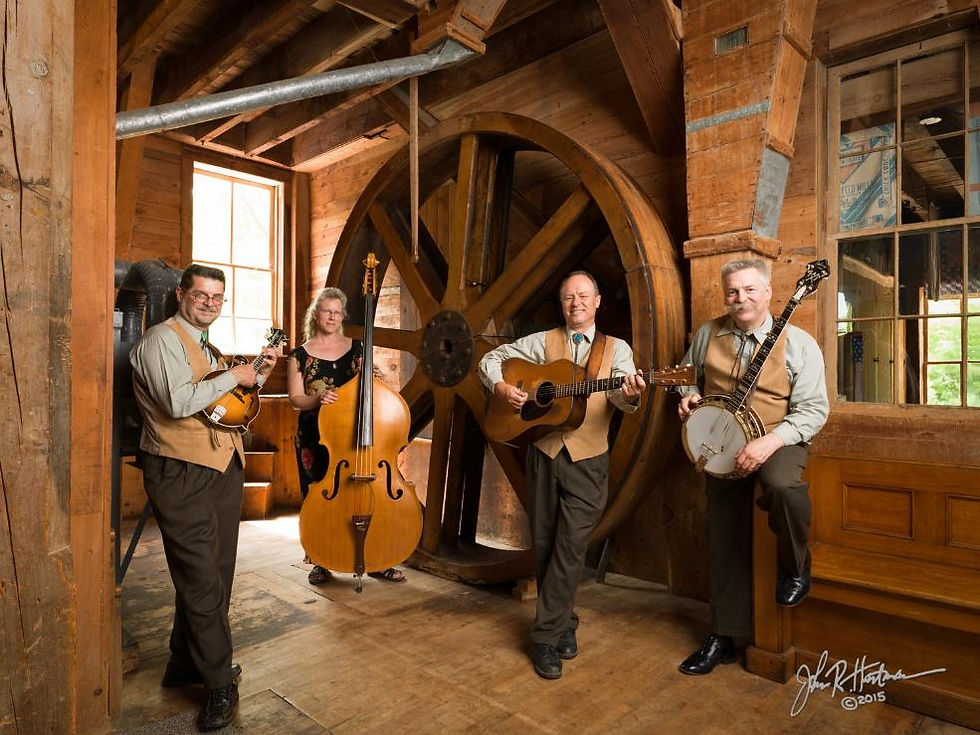
Art Stevenson & High Water (1993-current) In 1993, Stephanie Stevenson, Tom Boyarski, and I started playing every Thursday at Schmidt’s Corners tavern, north of Iola. After a short time, Tom Boyarski left and Dale Reichert, who had recently moved to Custer in eastern Portage County, came in on banjo and Dobro. Schmidt’s Corners was packed almost every Thursday night, with the parking lot full and people parked up and down the road to get in. We were the house band, and we hosted an acoustic open mic, with numerous guest musicians coming from Green Bay, Appleton, Stevens Point, and other communities. We played there every Thursday for over three years, until Stephanie and I moved to Madison in August 1996. We worked hard on our music, and it became clear to us that we could be a bigger attraction. Stephanie came up with the idea of High Water as a band name because we lived on a riverbank and had occasional floods. We agreed to put my name on because I was the band leader, lead singer, and I did most of the announcing on stage. This was my first time stepping out front as a band leader, and the band is still going strong today after over 32 years in the business.
By 1996 we added Chris Silver, from Saint Paul, on mandolin and fiddle. He stayed with us until 1998, and Chris still returns to play with High Water from time to time. The band recorded its first CD in 1996, and I mailed them to radio stations around the USA and Canada. The record was well received by radio show hosts, and the Bluegrass Unlimited magazine wrote an encouraging review, highlighting the duet singing Stephanie and I were doing. Stephanie and I moved to Madison in 1996, and in 1998 the band released its best-selling album “Dusty Boxcar Wall,” with spectacular reviews. The record was described by one DJ as an outstanding independent record release, with extraordinary duet singing. Dusty Boxcar Wall picked up the Bluegrass Album of the Year from Crossroads Magazine in 1999, beating records by Doc Watson and other well-established stars. Len Springer, of Madison, joined the band on fiddle and we released two more CDs in quick succession, “Lonely Days” in 2000 and “The Winding Stream” in 2001. Winding Stream made Album of the Year in 2002 on KBCS, Bellevue, Washington, although we never played out there. In 2001, Len Springer left the band and Bruce King, of Milwaukee, joined on mandolin.
Meanwhile, Stephanie and I had moved to Junction City in 1999. With Dale Reichert, we started a weekly Bluegrass Wednesday show at the Northland Ballroom near Iola, which we hosted for seven years. The Bluegrass Wednesdays became popular with UWSP students, and the Ballroom didn’t frequently check IDs, so the young college students came out by the hundreds! They danced and gathered around the stage during our opening set, then jumped up on stage at the end for handshakes and hugs. On a good night the Ballroom was packed shoulder to shoulder, three deep at the bar. We had an acoustic open mic, and each week there were many talented guests. In 2003-2004 Dale Reichert produced a radio show, The Northland Jamboree, which released seventy 15-minute shows to WWSP 90FM and other radio stations around the country. The show was recorded live at the Northland Ballroom hosted by Art Stevenson & High Water, and it featured regionally and nationally known guest musicians and bands. In 1999 we held the 1st Annual Northland Bluegrass Festival at the Northland Ballroom, which became a successful annual event, with regionally and nationally known artists featured. In 2010 I started a new event, Bluegrass In The Pines, located at the Rosholt Fair Park in Rosholt, Wisconsin, which has since been held annually at that location.
In 2025 Art Stevenson & High Water continue to have a busy schedule performing, mostly around Wisconsin. Stephanie Stevenson retired from the band in 2020, and Bruce King’s son Bruce Royal King joined the band on bass and vocals.
Art Stevenson & High Water Discography on CD, including Side Projects:
1996 Art Stevenson & High Water (self-titled)
1998 Dusty Boxcar Wall
2000 The Land That I Call Home (Spencer Sorenson album)
2000 Lonely Days
2001 The Winding Stream (Art & Stephanie Stevenson album)
2004 Like A River
2004 You Have Been A Friend To Me (Possum Holler Boar Hogs album)
2006 John Deere
2008 Prairielands (John Hanson banjo instrumental album)
2013 Twilight
2023 Bluegrass Harmonica (Art Stevenson with High Water and friends)

Thank you for reading this music history, presented together with the Portage County Historical Society's feature exhibit!
Be sure to visit the exhibit in-person during open hours and check out the digital collection of local music history.


