
Echoes of Victory - 100 Years Ago Today

The 1926 Stevens Point Depot Explosion
by Eva Woodward-Hathaway
In March of 1926, Stevens Point, Wisconsin, was poised for an upset. The high school basketball season was winding to a close, and against all odds, Stevens Point had become a contender. The Wisconsin State Journal called the team “one of the darker of the dark horses.” Yet on Saturday, March 27th, they stunned River Falls in the championship game. Against the odds, they had done it.
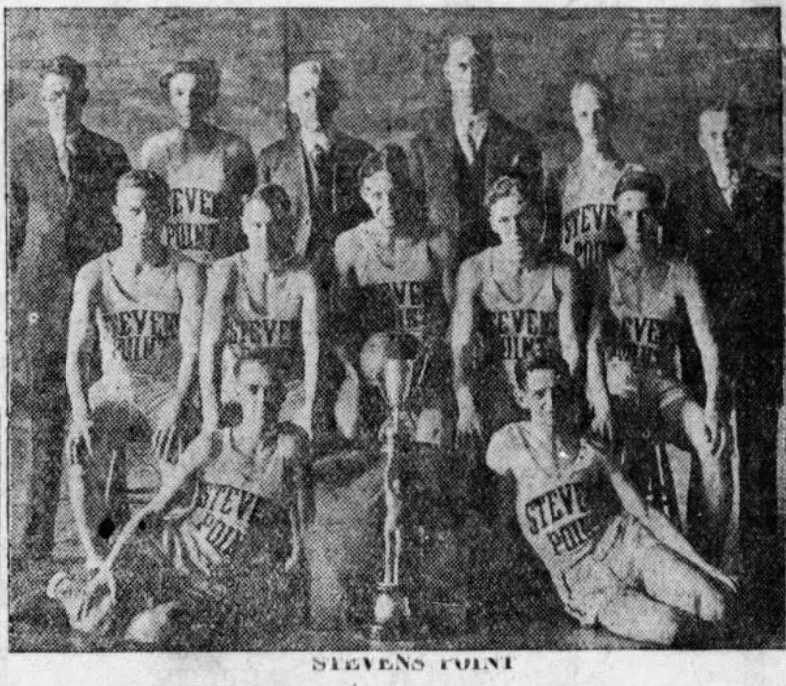
Back at home, the city of Stevens Point was electric. On Sunday afternoon, more than two thousand people crowded the Soo Line railroad station to welcome their champions back from Madison, where the tournament had been held. The local paper compared the celebration to the delirium brought on by the first Armistice Day. As Train No. 5 pulled into town, the engines in the yards joined the chorus— bells clanging, whistles shrieking, steam cutting through the crisp March air.

Another festivity was planned. Captain A.L. Oberst of the Wisconsin National Guard had granted special permission for a gun salute in the team’s honor. Members of Battery D, 120th Field Artillery, used horses from the battery’s armory to haul a French 75-millimeter field gun- an artifact of the Great War- to the depot.

Blank shells are used for military salutes, in this case brass shells weighing 4lbs each. Prior to use, a half-pound of saluting powder was loaded into each shell, compacted, and held in place by a couple of 1/2 inch-thick felt washers. For the day’s celebrations, four shells had been prepared to fire as the train arrived.
The first three salutes were fired off cleanly. The fourth never made it into the chamber.
As the breech was swung open to eject the spent third shell, a tongue of flame and thick white smoke shot backward. The waiting shell, resting on the gun’s tail, ignited. In an instant, it detonated: an eruption of smoke, fire, and flying scraps of brass that sprayed in all directions.
Four guardsmen were injured in the blast. Corporal Allan Holman, the gunner, took the blast to his face and hands. Privates George Frank and Ed Puzdrowski were burned across their cheeks. Corporal Harold Paukert was the most severely injured— his left leg was torn open above the knee, lacerated to the bone, the skin around the wound site burned.
In the excitement leading up to the salute, almost no one noticed the small boy standing just behind the soldiers. Seven-year-old John Kropidlowski had slipped away from his family to get a closer look. One of nine children, he’d found his way to the group of guardsmen, eager to watch the salute in action. The explosion reportedly threw him ten feet into the air. A fragment of brass opened his thigh to the bone, severing his femoral artery. He was unconscious as he hit the ground.
Despite, or perhaps because of the size of the crowd attending the celebration, not many people realized how serious the accident was. After the explosion, those nearby surged forward and cars were quickly appropriated in order to transport the five wounded to the hospital. Meanwhile, the majority of the crowd, unaware of the full scope of the tragedy, surged downtown behind the victorious team.
John was rushed to the hospital to be operated on in the hopes that he could be saved, but he had simply lost too much blood. He died within the hour.

An investigation into the accident was called for immediately. The Army called it a “freak accident”, an event “almost unheard of in army annals.” A formal investigation was launched, but within four days, it was closed. Whatever the officers found, they kept to themselves. No statement was released.
The guardsmen injured in the accident all went on to recover. Allan Holman was released the day after the accident, but contracted scarlet fever a few days later due to shock and his exposure while in the hospital. Ed Puzdrowski was out the same day after being given a tetanus shot as a precaution (due to the brass shrapnel). George Frank improved enough to go home by the following Wednesday, and Harold Paukert was released by the end of April.
John Kropidlowski was buried on Wednesday, March 31st, in the Guardian Angel Cemetery. At the bottom of his headstone, there bears a plea in Polish— Prosi o zdrowas Maria. Please say a Hail Mary.
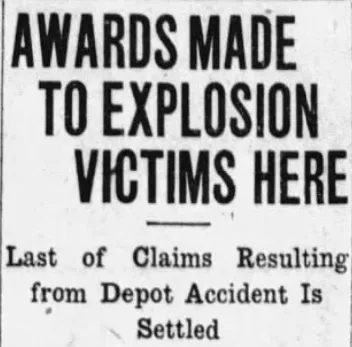
Whatever was found during the investigation, by October of 1926, the accident was being referred to simply as a “premature explosion”. Each of the four injured guardsmen received settlements, since they were state employees who were injured while on the job. Corporal Paukert’s case was the last to be settled. He was awarded $400 for his medical bills, and further compensation of $475 to represent a percentage of his wages.
Compensation for the Kropidlowski was more challenging. Under state law at the time, according to the Stevens Point Journal, “it (was) impossible to make any award for such a death other than by special legislation”. A bill was being prepared by the adjutant general’s office on behalf of the family.

The bill asking for $2000 to compensate the Kropidlowskis for the loss of their son John was passed in February of 1927. The next step was ratification from the Senate before it could become effective. The Legislature’s Joint Finance Committee went on strike the same Spring, which held the proposal up further. On May 10th, 1927, the senate voted 18 to 10 to veto the compensation.
A petition went around the community of Stevens Point, gathering more than 100 names from public officials and local business owners alike, asking Governor Fred R. Zimmerman to sign the bill and pass it into law. On June 9th, he vetoed the bill, insisting the National Guard hadn’t been acting in an official capacity when the explosion occurred. The State, he said, bore no responsibility. If restitution was to be made, it should come from the city itself.
The Stevens Point Journal lamented the decision in a short editorial: “The amount was small, and we are sorry that the governor did not give his consent to its payment.”
And with that, the issue faded. The 1925-1926 season is remembered— the year the dark horse team claimed its first state title— while John Kropidlowski’s name is mostly lost to history.
Eva Hathaway's blog: https://www.instagram.com/pointrevivals


