
Rock and Roll in Portage County

As part of our PCHS feature exhibit, each month through December of 2026 we will share a new piece of music history. Be sure to come back to learn more about the music that makes Portage County so great!
Rock and Roll in Portage County was researched and written by Cheyenne Witzeling, Art Stevenson, Pat Pfiffner, and Bill Berry.
The History of Rock and Roll
Rock and roll originated in the United States in the 1950s. By the 1960s it had evolved into what we call rock music. But how did it become a distinct genre?
In the 1950s the United States was seeing deep turmoil over civil rights and cultural supremacy. Black culture was beginning to be picked up by more mainstream companies. Not just jazz anymore, Black vocal groups like the Dominoes were using gospel-style harmonies with blues rhythms and contemporary topics in their lyrics. These groups wrote early earworms that brought snippets of Black culture to the record player and the radio. Rock and roll was first a description of the dancing that the audience did and later the dancing helped define the genre. In 1954 a singer emerged who would become the face of the early rock and roll movement; Elvis Presley.
Presley’s music was some of the raunchiest music that was publicly promoted at the time. His mix of different styles made his music feel less like a single genre and more like a feeling. This feeling of being constrained and wanting to be free was what drove rock and roll music. Some singers, like Buddy Holly and Little Richard, were wrapped in the same rock and roll label when before they would have been called rhythm and blues artists. Others, like Bill Haley and Elvis Presley would have been labeled as country because of their prominent use of guitar, but they now fit the rock and roll label instead.
While it may seem mild today, rock and roll artists were singing to teenagers on both sides of the Civil Rights conflict. For young white Americans this music sounded like rebellion. Some parents were scandalized by the genre and labeled it the “devil’s music”. Big record labels bought up popular artists and bands and slowly sanitized the genre; bands that had been singing about fighting the power were now singing about girls at the beach. By the mid-1960s the genre had been splintered into numerous styles that were all labeled rock. The most notable style to evolve was hard rock or heavy metal; this genre relied on thunderous guitar riffs, powerful vocals, and cascading drums. Heavy metal bands like Led Zeppelin and Black Sabbath became the next polarizing force in music.
Portage County certainly didn’t avoid the rock and roll craze. As early as 1955 the Stevens Point Journal tried to explain what rock and roll was, calling it “a beat that makes you want to dance” because you couldn’t lose the rhythm. Radio stations played the hits and record stores were selling plenty of stock. It was up to venue owners to try hosting the music and publicizing it, and many were wary. The Comet Bar on Highway 66 hosted the Greg Sherman Trio in 1958, advertising that they had imported rock and roll music just for the weekend. By 1960 the New York Bar in Mosinee was hosting rock and roll nights every Friday and Saturday and venues in Portage County like the Merryland Ballroom in Rosholt and Skipp’s Ballroom in Stevens Point were hosting traveling rock and roll groups. Today variations of rock music can be found around Portage County on almost any night of the week.
Rock and Roll Bands and Artists from Portage County

Myrna Cornwall was Stevens Point's first lady of rock and roll. Stevens Point musician Ron Hanson is credited with starting Stevens Point’s first noteworthy rock ‘n’ roll bands. Ronnie & The Bonnevilles and The Rockin’ Bops were active in the late 50s and early 60s. Young Myrna Cornwell got her start sitting in with Ron’s early bands as a guest singer. Then she joined The Furys, who were “one of the original bands that really had a name around here” according to Bob Wray, The Orbits’ first bass player. The Furys may have been the first Stevens Point rock band to make a record, releasing “Run To Him” backed with “Jenny” as a 45 RPM single on the Dee Jay label in 1962. Stevens Point-born Myrna Cornwell (1943-2000) played rhythm guitar and sang with The Furys. She was a versatile musician, and became the first local female pop and rock singer to achieve name recognition. The Stevens Point Journal lists numerous appearances by The Furys in the early 1960s. Ron Hanson and musicians from other local bands would frequently appear with the Furys’ regular members Dave Kulas, Norm Hanson, Jim Baumgart, and Myrna Cornwell.
In 1963 Myrna moved to Alaska for a long-standing engagement at the Hi Hat Club in Anchorage, where she sang country western and rock ‘n’ roll, and played guitar, drums, and piano in the house band. She stayed in Alaska until 1965 and returned to join The Orbits. Bob Wray, the original bass player for The Orbits, says “Myrna joined the Orbits after her return from Anchorage in 1965. Around ‘66 she and I and the Orbits’ drummer (John Anheier) left the Orbits, hired a guitar player (Tommy Kay), and formed Myrna and the Avalons.”
Myrna and the Avalons quickly became a popular act, in demand across central and eastern Wisconsin. Bob Wray recalls, “a lot of people remembered Myrna, a lot of people knew who she was back with The Furys. So that was kind of a big boost for the band because people knew who she was, you know, and so we were able to book just off that.”
In 1967 Myrna joined a full-time touring band and went on the road for a spell. In the early 1970s she rejoined the newly reorganized Furys. The next several years found Myrna working on and off with Southern Comfort, a popular local country western band. Myrna’s name was featured on posters and notices of Southern Comfort’s appearances. Other than occasional Furys reunions, Myrna left music to concentrate on running a business. Stevens Point’s first female pop rock singer and band leader passed away in 2000.

The Orbits (1965 - 1978) was a band of constantly-changing musicians. Take a look at this list of the original and early members!
Ron Hanson, guitar/vocals
Ron Glodowski, guitar
Donnie Schultz, bass
Robert Schultz, bass
Glen Shulfer, guitar
Mike Daily, vocals
Ed Niespodziani, keyboards/vocal
Bob Wray, bass
Joe Cory, keyboards
Myrna Raatz, vocals
Steve Berndt, bass
Ron Pitt, bass
Dave Trickle, bass
Rick Martin, drums
Jim Sether, drums
One of the earliest and most influential rock bands in Portage County and well beyond, The Orbits had a revolving cast of up 50 different players, several who went on to stellar national careers. The band toured extensively and backed up national acts for several years. But it will always be known as a Stevens Point band.
Of all the musicians, one name stands out. Ron Hanson founded, fronted and managed the band for many years. In addition to other business interests, he ran a music store out of his home, where many young musicians bought their first guitars, or, in the days before rock took over, accordions.
Lead guitarist Glen Shulfer, who played with The Orbits from 1967-74, had this to say about Hanson, “I call him the grandfather of rock bands in Stevens Point. The thing that is unique about him, he would talk to any kid who had a question or problem. He would take the time and talk to anybody. He loved people who were interested in music, and he wanted to help. I can’t emphasize enough the importance he had in the whole city.”
Hanson recruited Shulfer in 1967, noticing him playing in a folk Mass group at St. Joseph’s Catholic Church, where Hanson attended. Shulfer was 14 at the time, so Hanson served as his chaperone when they played bars.
Shulfer, who went on to study classical music in Europe and then returned to teach in the University of Wisconsin-Stevens Point music faculty, developed one of the first guitar programs in the Universities of Wisconsin system. But he relishes those early rock days.
“Every time I talk to another musician my age, we kind of reminisce about and lament the passing of those times when we grew up from late ’65 to ‘72-‘73. There were so many bands, so many places to play,” he said.
Local venues that stand out for Shulfer included Poor Henry’s, which was a teen joint near downtown Stevens Point, operated by Hank Duda. “Poor Henry’s was number one. We did 100 gigs at Club 66, also the Youth Center (Stevens Point Recreation Center.) There were dances everywhere. You could go anywhere and see four or five bands any weekend night. They did rock and roll every week at the Pacelli gym” He also recalled playing to full houses at the well-known Indian Crossing Casino on the Waupaca Chain O’ Lakes.
The Orbits recorded a number of songs, and Shulfer wrote perhaps the best-known, “House Without a Roof.” In later iterations, the group toured as Kansas City Road Band. Hanson was no longer in the band, but he served as manager. They toured extensively, opening for major acts, including the Grass Roots, a band that included keyboardist and singer-songwriter Dennis Provisor, who ended up retiring to the Stevens Point area and briefly started a band called The Hits.
Now living in Florida, Shulfer continues to work and has a diverse catalog of 300 originals, from classical to rock to Christian music. He returns here periodically and has deep feelings about his hometown. “I just appreciate having lived in Point at the times I lived here and all the people who came to see us, whether it was classical recitals, rock gigs, church music, all the people that gave any support and made what I did worthwhile. It’s not about the money or anything like that. It’s that people enjoyed it.”
Another musician who got an early start with The Orbits and later went on to success on the national stage was bass player Bob Wray. Also in the Orbits during Wray's stay was Myrna Raatz, who earlier had worked with the Furys. Wray and Raatz married and left the Orbits to form Myrna and the Avalons. Later, they divorced, and Wray toured with Travis Wommack, an early and influential rock guitarist. Wray moved to Muscle Shoals, Alabama, to do session work there and in Nashville. He also toured with The Marshall Tucker Band, Crystal Gayle, and the Highwaymen (Johnny Cash, Willie Nelson, Waylon Jennings, and Kris Kristofferson. He played on hit records for many stars. He’s still engaged at Muscle Shoals.
Not every musician who played with The Orbits traveled as extensively as Wray and Shulfer, but drummer Joe Schultz of Plover was well-traveled among local bands, including the Orbits, Powerhouse, Shine, Gamblers, Southbound, Relentless and Fran and the Night Train, all bands that many local live music lovers recall. He gigged with The Orbits from 1970-73. His brother, Robert Schultz, the band’s drummer, went to Vietnam for military service in 1969. “He left his drum set in the basement,” Joe Schultz recalled. His cousin, Donnie, was also in the Orbits.
Joe Schultz was still a high school kid when he joined The Orbits. “There were a lot of musicians in Portage County in the ‘60s and ‘70s,” said Schultz, whose family home was on East Avenue in Stevens Point. “My parents knew Ron Hanson, and he was old enough to be my guardian when we went in bars. That was interesting. I don’t even know how I did it. The Orbits were quite a bit older than me.”
At times, musicians were interchangeable parts in local bands. “A lot of times, it seems when bands traded members, it was two at a time. The Orbits were looking for a bass player and a drummer when Ron Pitt and Ricky Martin left. I replaced Ricky, and Steve Berndt replaced Ron.”
Joe Schultz and his brother, Steve, operated Happy Feet Shoes in Stevens Point for many years.
Another local musician who had a stint in The Orbits was Eddie Niespodziani, one of the founders of another top local rock band The Rejects. He joined The Orbits in 1969 and played with them for a few years. “We toured quite a bit with The Orbits and had pretty good lineup. The lineup changed quite a bit. Ronnie Hanson had the money, the bus, the music business. He had a music store, so we had great instruments. Ronnie had connections with a variety of guitar amp companies so he would arrange for us to get all equipment free if we put their names on stage. Everybody had two (amplifier) bottoms and a top. We had eight bottoms on stage.”

The Rejects (1964 - 1967) is one of the best-known young rock bands from Stevens Point. In 1964 a guy in his 20s named Ray Goddard decided to get together with four young high school kids who were forming a band in Lawrence Niespodziani’s garage in Stevens Point (a garage band!). They were Thom Niespodziani, drums, Ed Niespodziani, lead vocals and front man, Dale Bartkowiak, bass, and Joe Ebel rhythm guitar. Ray played lead guitar. They needed a name so when they were sitting around a “record player,” they saw the tone arm “reject” from the record and return to its starting spot. Wow, they thought, that’s it, the name they needed. THE REJECTS.
The Rejects played all the covers from the 60s in places like the armory in Stevens Point, the Pacelli HS gym and at various bars all over Central Wisconsin. Ray had a VW bus that was painted metallic green and fit all of the equipment and 5 guys in for trips. It was called “The Fink Wagon.” The only seat was the front bench seat and 4 guys sat on it and Joe would lay across the back of the seat for trips. Can you imagine that nowadays? There was no insulation so frost would form on the INSIDE so you can imagine how cold it was during those Wisconsin winters. “The Fink Wagon” went along with “the Fabulous Fink Sound” of the Rejects.
In fall of 1965, Ray left to do other things, Joe became the lead guitar player, and they thought, we need a gimmick to make up for the loss of Ray. I had been hanging around with these guys all along and had been playing in various other bands in Point and the guys thought, how about two drummers? So, I joined the Rejects and Thom and I worked out a system so we could work together. We had matching red sparkle drum sets. How cool is that? We continued to play all over the state and thought nothing of driving 100 miles in one direction on Friday and coming home and going 150 miles in the other direction on Saturday for another job. We played lots of beer bars and occasionally a 21 bar. You could drink beer at 18 in Wisconsin back then. Since we were all underage, we had to be on the stage, in the restroom or outside during the gig. With the loss of the Fink Wagon, we needed something to carry all the equipment so we bought the Fury’s old trailer, which was painted with red and white stripes up and down. The Furys said we had to change the paint job so Ed and I painted it with red and purple diagonal stripes with “REJECTS” painted across each side and it was pulled by my 1963 white Chevy 409 convertible.

It was around mid-1966 when we thought about making a record. Joe wrote a song called “Find Your Man,” and we recorded it at Big Sound studios in Wausau, WI. After recording it, the engineer said, Ok, let’s do the B side. We all looked at each other and said, “B SIDE?” We had nothing. So, we put together a one chord hodgepodge and called it “Hey Girl.” The middle section was a guitar solo with Ed counting the measures out loud so we knew when to end it because I was playing sixteenth notes around the tom toms through-out and Thom was playing time while Joe soloed. Then back to the top of the song. You can hear Ed yelling out the measures.
After Thom graduated from High School, he decided to go into the Air Force, so the Rejects went back to one drummer (I didn’t want any more competition) and Ed picked up the organ along with his singing duties. The organ was a Farfisa “Combo Compact.”
We continued to play all over Wisconsin but played the Indian Crossing Casino almost every two weeks during the summer months. There we opened for Buffalo Springfield, a legendary rock band with Neil Young and Stephen Stills in its ranks! The Rejects played the first set and the crowd went wild. The Buffalo Springfield came on and pretty much bombed. No one was impressed. The Rejects came back on and everyone loved them. Up in the dressing room the Rejects witnessed the manager of the Buffalo Springfield chewing them out and saying this young band made you guys look terrible. That was an amazing experience for us young musicians back then. The Buffalo Springfield came out the next set and kicked butt. They wouldn’t let those youngsters beat them again. To this day, many people remember the night when the Rejects showed up Stephen Stills, Neil Young and Buffalo Springfield.
Playing with the Rejects was an absolutely amazing experience and we had the most fun you can imagine during that time period. It was a big deal for kids to get a ride in the Fink Wagon and we got to play this great music and travel all over Wisconsin. We also had an article written about us in the Milwaukee Journal. We were Rock Stars but didn’t know it.
The Rejects broke up in August of 1967 when Joe and Pat went into the Navy and Dale went into the army. It WAS the Vietnam Era after-all. Ed joined the Orbits for a long run. Pat saw them when he was on leave from the Navy.
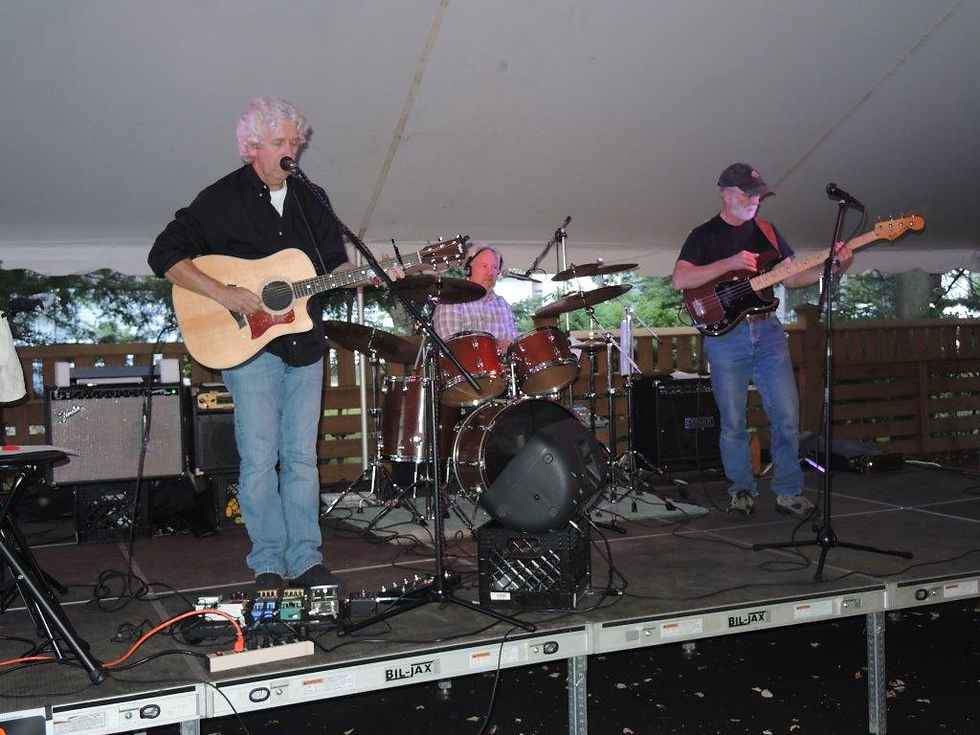
Gray Catz (2011 - current) have been around Portage County for almost 15 years. Music lovers in central Wisconsin know the Portage County-based Gray Catz well. Stevens Point natives Dan Alfuth, bass, Jeff Ebel, drums, and Frank Stanislawski, guitar, comprise the trio known for a wide-ranging repertoire and clean three-part harmonies. The band sounds smooth for good reason. The three love practicing and do so regularly in Ebel’s studio.
Their first gig was December 30, 2011, at Club 10. The Gray Catz may be the final stop for these three guys, but it sure wasn’t the first. They share a collective total of at least 150 years of performing in numerous bands that have entertained people across the county, state and beyond. These days, most of the gigs are in Portage County. Wherever they go, they draw a crowd.
Here’s a bit of background on the many musical connections of the Gray Catz.
Dan Alfuth: Like bandmate Stanislawski and other musicians interviewed for this exhibit, Alfuth started with the accordion. Jim Laabs, longtime Stevens Point music store owner, was his teacher. Accordions were popular first instruments for many young musicians in those days, and not just in Portage County with a Polish population that loved polkas. They were a lot more portable than pianos. “I was in the fifth grade, and I could read music, which I have no idea how,” he recalled of his accordion days. “Then there was a guitar symposium at Quandt Gym in 1968 or ’69, and I said, ‘I’ve got to get rid of this accordion.’ ” Soon he was playing in a band called Aire with other local kids Joe Schultz, Rick Bartkowiak, Jim Philips and Pat Houlihan. “We had to have our dads drive us to bars (for gigs) because we were too young,” Alfuth said. His dad, Joe, was also a musician, playing banjo and guitar in local bands, including one called The Northerniers.
“In 1973, I had just graduated out of high school, and a week later moved to Marshall (near Madison) with Terry Knoll, John Hartman and Joe Schultz. We had a band called Power House and played for a year or so.” Bandmate Joe Schultz recalled in an interview for this exhibit that they lived in a farmhouse and practiced virtually every day.
Alfuth returned to Portage County around 1975 and played in a band called Blue Ribbon Gamblers, his first of several bands in which Stanislawski was a band mate. The band also included Chris Davis, Pat Bowe and Tom McComb, a well-known local musician. Later, he played with Fran and the Night Train, a band fronted by Fran Glodowski. Her husband, Bobby, was also in the band, as was Joe Schultz. Alfuth and Stanislawski played together in a popular country rock band called Heartstrings, along with Dave Olsen, Dan Halverson, Pat Houlihan and Jim Prideaux.
In all, he played in about 15 bands across six decades. Among them was The Gamblers, a 1980s country band that included Frank Stanislawski, Dan Halverson, Joe Schultz and Scott Neubert, who went on to tour nationally with country bands and own a music studio in Nashville. “In the ‘60s and ‘70s, Stevens Point and Portage County had a lively music scene. It seemed like every other block had a band.”
He also played in seven reunions of a popular country rock band called Daddy Whiskers, which shared the stage with Heartstrings at the Indian Crossing Casino. The reunions were held yearly until the Covid pandemic shut down many music venues. The Daddy Whiskers lineup for those gigs included band mates Stanislawski and Ebel, along with Randy Bruce, Neubert and Tom Dehlinger.
In the early 2000’s, he joined Stanislawski and his son, John, in a band called First Last Call. When John Stanislawski went off to get a Ph.D. in music at the University of Illinois, Gray Catz was born, and they're still playing to this day.
Bands are always on the prowl for bass players and drummers, and Alfuth kept a list of his stints with various bands over the years. They included Kathy and the Poor Boys, fronted by Kathy Mancl; Fran (Glodowski) and the Night Train; Stagecoach; Southbound; Arthur; Heartstrings; Gamblers; North Wind; Heartwood; First Last Call; Daddy Whiskers, and, of course, Gray Catz. Some of the bands were rock, some country, some a bit of both. All had their moments, but Daddy Whiskers, a country-rock band, had a great run that led to several “Oldstock” shows along with Heartstrings at the Indian Crossing Casino on the Waupaca Chain O’ Lakes. The last of those shows came in 2022. The original Daddy Whiskers lineup included Randy Bruce on rhythm guitar and vocals; Stanislawski on lead guitar and vocals; Danny Bartkowiak on bass; Joe Ebel on lead guitar, fiddle and vocals; and Jeff Ebel on drums and vocals. Others who performed with the band through the years included Greg Curran, Ross Goltz, Gale Barchus, Tony Menzer and Jack Hurrish, all on bass; Jim Ohlschmidt, Scott Neubert, Mike Bestul and Tom Dehlinger on guitar; Pat Bowe on harmonica and vocals; and Paul Bentzen on banjo in the studio. To longtime area music fans, many of those names are well known.
As with his Gray Catz chums, Alfuth had day jobs, too. He owned Campus Records in Stevens Point from 1979-87. He also worked at Ellis Electronics, Krause Publications for 12 years and at the Waupaca Foundry, where he was in charge of information technology for 15 years.
But bands and gigs were a constant in his life.
Like his pals in Gray Catz, music has always been a big part of his life. “Ever since 1969, I’ve played with somebody. I’ve never really had any time away from playing.”
Jeff Ebel: The longtime Stevens Point resident from a musically inclined family got his start in 1965 when a cousin left a drum set at the Ebel home, where Jeff’s brother, Joe, was on his way to becoming a guitar virtuoso, joining the seminal rock band The Rejects as a young teen.
“I got started after hearing the Dynamics at the Youth Center,” Jeff Ebel recalled. “They were drummer Bob (Robert) Schultz, guitarist Bob Carol, who had an incredible voice, and Donnie Schultz, a bass player who also played with The Orbits. I saw Bob Schultz and thought that was awesome.
“I got my own first drum set when I was 14, and I played my first gig that summer and thought I was going to die, I was so scared. Through high school, I played in a band called The Sounds, which later changed its name to Sound Street.”
A phone call as Ebel was preparing to head to college at Washington State changed his life forever. “The car was packed, and I was ready to say goodbye to mom and dad. Then the phone rang. It was Jim Wray, who was roadie-ing for a band called US Pure, and they were looking for a drummer. I took the job and ended up not going to Washington State.” He worked on the road with a few other bands, then came back to Point and joined the country-rock band, Daddy Whiskers, his first go-around with Stanislawski.
He played with several other groups, including a short-lived band with his brother, Dave Trickle and Pat Houlihan. A second stint with Daddy Whiskers came next, then in the 1980s he played with Thirsty, which included brother Joe, Ted Mitchell (he of Mitchell Piano Works) and the late Steve Berndt.
In the 1990s, he was drumming with Mr. Twister, which included Rod Kaiser and Jack Hurrish, both well-known local musicians. “I also gigged with Marge Schroeder, and for a time with Fran (Glodowski) and the Night Train, a band that continues to perform.
“Playing in bands was the greatest. I’d make 25 bucks a night, two times on weekends. That was good money.”
Like Alfuth and Stanislawski, Ebel had a “day job” over his many years of gigging, including at the now defunct Lullabye Furniture and Ministry Health Care. But the band money was good, especially at a time when he started his own business and needed the income. He quit gigging for several years because of carpal tunnel syndrome but after getting that repaired, he was back at it, joining his current bandmates. This, he says, is his last stand. “When we’re done, I’m done.”
Frank Stanislawski: Soft-spoken and unassuming, Stanislawski handles lead and rhythm guitar duties and vocals for Gray Catz. Only the best guitar players manage both rhythm and lead, which is why trios aren’t as common as four or more piece groups.
“I, too, started on accordion,” he said. “I was a fourth grader. Jim Laabs had National Keyboards Studio, which was above Shippy Shoes (when the shoe store was on Main Street in downtown Stevens Point). I’ve known Jim for all these years. I did learn to read music, but my ear got in the way. I would look at the chords, listen to the music and play it.”
Then came the invasion. “I saw The Beatles on Ed Sullivan, and I said, ‘I’ve got to get a guitar.’ What happened was Tom Flugaur (guitar), the (former Portage County) judge and Gary Flugaur (bass), his brother and Alan Maslowski (drums), were school mates of mine, and probably in sixth grade, they’d gotten electric guitars for Christmas. They had matching orange Hagstrum guitars, and they said, ‘Why don’t you get a guitar?’ I really wanted an orange Hagstrum, but Jim Laabs only had a baby blue one, so I got that. We got a few gigs, playing at the Municipal Pool. Our first gig was actually in front of Jim Laabs Music in ’65, at downtown Crazy Days. I remember doing California Sun. It was the first lead I learned. That band lasted for a few years.
“In eighth grade, I played with Tom Dehlinger and Mike Cooper in a band called The Rhode. We did Monkeys stuff and a little psychedelic stuff. Then I played in Your Father’s Mustache with Dave Bronk, Dave Worzalla, Andy Erickson and Steve Berndt. “Andy was a Cream fanatic, and he played it well. So we did a lot of Cream stuff. Mike Klesmith also played drums with the band. He had played with the Orbits for a while. “
From there, it was Blues Illusion, with Jerry Drapes, Ted Mitchell and brothers Mike and Larry Jorgenson. Despite the band’s name, it didn’t play blues.
“Then came Mesa, with Randy Bruce, Dan Bartkowiak, Jack Hurrish, Bob Schultz and myself. Bob was the original drummer, and was later replaced by Al Crowe. The group toured the region extensively, playing three or four nights a week. Eventually, the band broke up, and Stanislawski, Bartkowiak and Bruce formed Daddy Whiskers, joined by Jeff and Joe Ebel. That band had two different runs.
Both Mesa and Daddy Whiskers traveled across the state, opening for acts like Mason Proffit, one of the top country-rock bands of the ‘70s. In the first decade of this century, Stanislawski and Alfuth were joined by Frank’s son, John, in First Last Call. John went off to earn a Ph.D. in musicology at the University of Illinois, and thus was born today’s Gray Catz.
Stanislawski had several day jobs, including a stint in the bakery at the old IGA southside store. “In the Gamblers, we occasionally played Friday and Saturday nights at the Super Bowl. I would work 4 a.m. till noon (at the bakery) go home and then be ready to play from 9 p.m. till 1a.m. Get home and maybe sleep an hour or two, go back to work at 4 a.m. till noon, go home, sleep as long as possible and be ready to play again at 9:00p.m. It was challenging, but I survived!”
He was a mail carrier for many years and sometimes carried his guitar in his mail truck to play at lunch time. You could say the mailman delivered.

Thank you for reading this music history, presented together with the Portage County Historical Society's feature exhibit!
Be sure to visit the exhibit in-person during open hours and check out the digital collection of local music history.


